
"Please Make Comfortable": The euphemism that killed hundreds in Gosport, and is still killing.
From suppressed nurse whistles to excessive drug volumes, Gosport reveals the bulletproof blankets of protection thrown around state healthcare.

Regular readers will know that I have grave concerns about the implementation of “covid treatment protocols” in the UK and elsewhere.
I believe that a significant number of lives were ended by the excessive use of drugs used ostensibly to “keep patients comfortable”, but which, in fact, were inappropriately prescribed, suppressed consciousness and respiration and thereby ended the lives of many victims prematurely.
The below article contains a systematic review of all the evidence for that assertion, though it’s now a couple of years old and no doubt much more could be added to it.

In the below piece, my co-author and I describe what happened at the Memorial Hospital in New Orleans in the aftermath of Hurricane Katrina. In essence, healthcare workers euthanised a number of patients using opiates, but the “establishment” subsequently closed ranks to ensure the protagonists were not found culpable of any wrong-doing:
Here, as part of my experimentation with Gemini AI, I offer a short (15 mins) conversational podcast drawing parallels between the UK’s Assisted Dying Bill (thankfully now itself killed off by the House of Lords) and the Nazi’s program to euthanise the infirm:
The Gosport War Memorial Hospital scandal
The other day, I came across this post on X about the Gosport War Memorial Hospital scandal.


I had been vaguely aware of this story in the back of my mind, but never really considered the detail. When you do, it’s shocking how many of the facets of both the “Covid” and Katrina euthanasia stories are present here also, in particular the God complex on display by doctors, their apparent (though unwarranted) unimpeachability, the closing ranks of the establishment, and the bulletproof blankets of protection thrown around systems of healthcare.
I uploaded the PDF of the final report from the Gosport Independent Panel set up to investigate the scandal to Gemini and asked it to do me a bullet pointed summary.
Here’s the summary:
1988–1991: A “Gosport Protocol” of institutionalized life-shortening through high-dose opioid prescribing begins, primarily under Dr. Jane Barton’s clinical oversight.
February 1991: Brave nurses hold a secret meeting to raise alarms about patients being sedated into death with diamorphine via syringe drivers.
1991–1992: Hospital management and the RCN suppress these warnings, characterizing the nurses’ concerns as “disruptive criticism” and forcing a culture of compliance.
1993–1998: Deaths at the hospital double, peaking at over 200 annually, as the practice of lethal “anticipatory prescribing” becomes standard operating procedure.
August 1998: The death of Gladys Richards finally triggers the first of three Hampshire Constabulary investigations that ultimately result in no criminal charges.
1998–1999: Pharmacy records show excessive orders of 1,617 diamorphine doses for rehabilitation wards, but authorities fail to investigate these massive drug volumes.
2000–2001: Dr. Barton retires; the “Protocol” ceases and annual death rates immediately drop back to baseline levels of approximately 100 per year.
2002–2003: Internal NHS management and mortality reviews are “placed on hold” at the request of police, effectively delaying institutional accountability for years.
June 2018: The Gosport Independent Panel confirms 456 lives were shortened by opioids without clinical justification, and likely over 200 more.
2019–Present: Operation Magenta, a major criminal investigation involving three million document pages, continues to review the case for potential future prosecutions.
I then asked Gemini to consider the report together with the above articles, and asked it to generate further material. I think it has done a really good job.
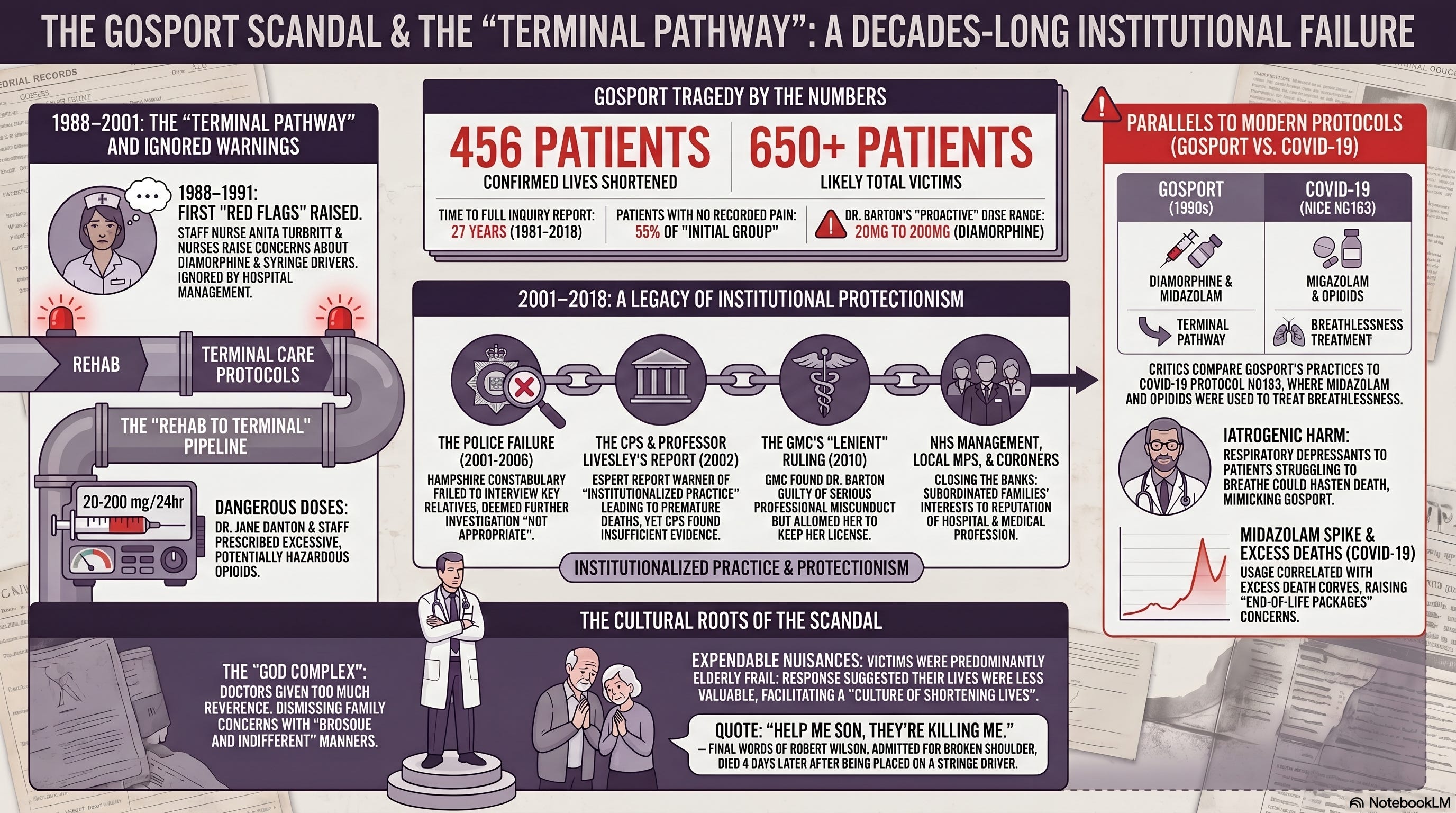
Here’s an infographic illustration:
A slide presentatation:
Finally, here’s a conversational “deep dive” podcast”; this one is a version generated using the “long” setting, and it’s 31 mins long.
Here’s a shorter (5-min) version for the time-poor:
I do find the voices of the “hosts” of the podcasts rather irritating, but notwithstanding that, this would appear to be a useful methodology for some people to gain an introduction into a new topic.
I’m interested to know what you think of the AI-generated material. I’m pretty cynical about AI’s abilities in general (see my articles here), and especially the suggestion that it is (or could ever be be) capable of generating any novel hypotheses or knowledge whatsoever.
However, I DO find it useful for summarising long documents, and also for synthesising existing material and presenting it in digestible ways.
My elderly (previously healthy) uncle underwent some sort of exploratory procedure to determine why he was complaining of a stomach ache.
He was then discharged.10 days later her was re-admitted to hospital, suffering from sepsis
He was "made comfortable" too, with the permission of his 4 children who didn't quite understand the attending doctor's "vernacular".
Whatever it was that this doctor "prescribed" killed him quickly. That happened in the presence of his youngest daughter who was the only relative permitted entry to his hospital room, during "covid protocols", in the 22 minutes that it took to euthanize him.
His wife wasn't aware of what was afoot either. She was at home...None of them knew what was about to befall my elderly uncle. It was a great shock.
I suspected.
Questioned my cousin as thoroughly as I could. Advised them, on Christmas morning, what I believe actually happened to my elderly uncle on December 23rd 2023, in a Northern Italian hospital.
We haven't spoken about what occurred in that hospital since that conversation...
"Oh well".
This is a good presentation of these events, I had not heard of it before. Thank you.
I agree that AI is good at some things. As you say, summarizing long and data rich documents or topics is something I use it for. But you do have to keep an eye on it. Insertions and swaps are commonplace. I like your info graphic, but the AI got creative with a drug name in there. Off to the right side in a comparison segment it changed Midazolam to "Migazolam." Most people looking at that will know it is a typo, but a few will not and may assume there is a different drug involved. This is the drift that AI needs to be watched for constantly.