
Dr Henry Marsh - euthanasia advocate: "the greater good" justifies some cases of coercion.

Henry Marsh is a (now retired) neurosurgeon who has been very outspoken in his support for an Assited Dying bill being introduced in the UK.
In November 2025 he appeared before a session of the UK Parliament’s Joint Committee on Human Rights during its examination of the Terminally Ill Adults (End of Life) Bill.
Yesterday a clip from that session was posted on X:
Transcript:
Speaker 1: I think you’re on record saying that obviously if there’s some cases of coercion, the greater public good is satisfied by having the system. Is that...
Dr. Marsh: In principle, yes. I know I made a very crass comment about sacrificing grannies. I greatly regret it. I wish I hadn’t said it.
Speaker 1: You didn’t want to say it...
Dr. Marsh: No, no, it was very stupid of me and I was, I didn’t realize it was going to get in the public domain. But the principle is there is always a cost. Everything has—every time I operated, and it was not a theoretical risk, you can make things worse. But you justify that risk by saying more people benefit. It sounds rather inhumane and utilitarian, but that is the reality of normal medical practice.
Speaker 1: Dr. Marsh, thank you for your candor on that. That’s appreciated.
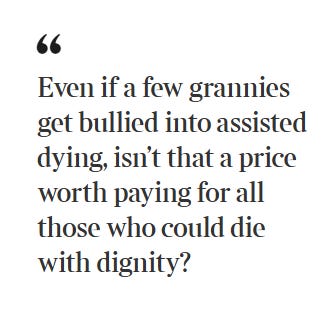
The regret Dr Marsh expresses relates to this article in The Sunday Times published in 2017, in which the “very crass quote” he refers to appears rather prominently:
I have several comments to make about this.
The “greater good” ideology
Firstly, many people would be surprised (or maybe not) to see a doctor so comfortable with bringing in utilitarian “greater good” ideology into the practice of medicine. I suspect that most assume that the doctor considers it their duty is towards each patient individually without such broader societal considerations.
He is comfortable with patients being “bullied” into killing themselves
Secondly, the very notion that it is OK if “a few grannies” (managing to be both ageist and misogynistic at the same time) get bullied into being killed - whatever the “cause” in pursuit of which they are collateral damage - is one that should be abhorrent to any right-thinking person.
He regrets his words - but only because they became known to the public.
In the clip,he says he feels stupid for saying those words. But it is clear that the reason for that is not that the words don’t truly reflect his opinions, nor that they were taken out of context, but rather that he shouldn’t have uttered them in the knowledge they were entering the public domain.
In other words, he regrets honestly expressing his actual opinion, and would rather have kept this particular view private.
One has to ask:
What others views do healthcare practitioners hold (relevant to medical practice) which aren’t generally known but that we ought to know about?
At this point, it is worth reminding ourselves that ethical boundaries which are generally thought - by the lay public at least - to be inviolable, are anything but:

Interesting that ‘they’ coerced people to get jabbed so as not to ‘kill grannies’ while espousing it not mattering if a few ‘grannies are coerced into dying’. Sheesh. The sheer hypocrisy of our institutions - and the sheeple that buy into all this planned destruction as it’s for the ‘greater good’ (and whose good would that be?).
Dr Henry Marsh must hate women - his arrogance is off the scale - and he should be the first to sacrifice himself For the greater good’ for he’s a well spoken evil little odious nincompoop