
Corrupting the Hill.
My AI quandry....

I’ve been doing more fiddling with AI - Gemini to be precise. To be clear, I do not think LLMs are capable of ANY interesting, nuanced analysis and AI cannot “create” anything1. It is not a direct danger to humanity per se, except as a result of the huge misunderstanding commonly held by people who wield the power to tax us and spend our hard-earned cash.
However, Gemini’s writing skills are pretty impressive; hence, as a tool for content creation to draw people into a topic, I am loath to dismiss it.
Take a look at the short story below which I asked it to write.
I gave it one post on X (this)2:
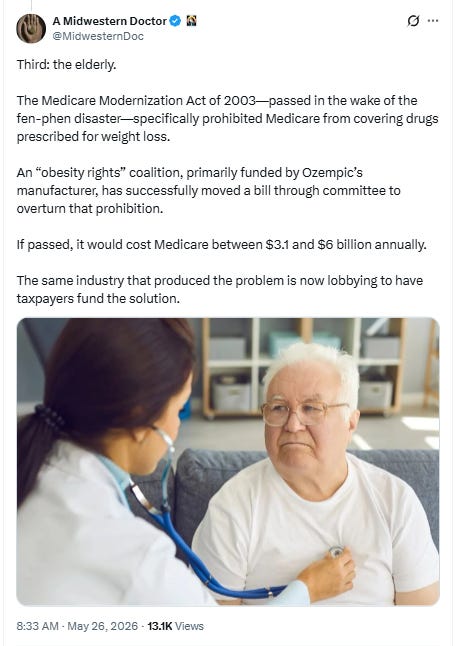
I then gave it an outline (in a fair amount of detail, it has to be said) of a short story which I asked it to write, based on that post.
I think the result is pretty good. It MAY open some people’s eyes as to the levels of corruption which are going on, seemingly in plain sight.
I was, obviously, aware of the undue influence that commercial entities have over health policy, but the sheer scale and brazenness of it is astonishing. It should be appreciated that what is happening (and this is not just in relation to the “fat jabs”) is this:
Big Pharma is funding (with varying degrees of transparency) a vast empire of fake “grassroots” coalitions, manufacturing public support from the top down.
They recruit, program, and weaponize everyday citizens, training them on how to parrot corporate talking points to politicians and lawmakers.
This is, therefore, a means by which massive corporations gain direct and unchecked access to politicians so they can work on them to rig policies in their favor.
I should point out that I am in two minds as to whether to use AI for this kind of task. Yes, I do realise that it may be subtly changing me and my own skillset. I do not want a world where individually human-crafted material is replaced by anodyne homogenised AI-generated “slop”.
But on the flip-side, propagandists and the enemies of humanity are using AI liberally, flooding the zone with BS - which people are (it seems to me) swallowing voraciously. We appear to be in an arms race, the weapon being information. So, there’s a case to be made for using AI to create counter-narrative material. I certainly would not have the time (or skills) to write something like this.
Anyway, here’s the story. I have only edited the chapter headings from Gemini’s output.
The Liturgy of Compliance
Chapter 1: the innocent warrior
The kitchen clock read 4:30 AM when Martha finished her breakfast: a bowl of skimmed-milk porridge, half a grapefruit, and a small pharmacy of daily compliance. There was the statin for her cholesterol, the blood pressure pill, and the low-dose aspirin. At sixty-three, Martha was a monument to public health orthodoxy. She had dutifully rolled up her sleeve for every seasonal booster, replaced butter with margarine in 1988, and viewed red meat with the suspicion normally reserved for unexploded ordnance.
Yet, when she stood up, her joints ached with the weight of twenty-two stone.
For forty years, Martha had believed her obesity was a character flaw—a failure of the “eat less, move more” gospel preached by every GP she had ever seen. The shame was a physical garment she wore every day.
Then, six months ago, she found the Metabolic Equity Network.
It began with a Facebook ad, leading to webinars where sleek, compassionate doctors explained that obesity was not a moral failing, but a chronic, relapsing disease. Martha felt a profound, intoxicating wave of absolution. When the network offered to sponsor her travel from Ohio to Washington, D.C., for a “Capitol Hill Advocacy Day,” she felt chosen. She was going to be a foot soldier in a war for human dignity.
Now, she was sitting in the ballroom of the Grand Hyatt in Washington, surrounded by three hundred people who looked just like her. For the first time in her life, Martha felt entirely safe.
At the front of the room stood Chloe, a twenty-something coordinator with immaculate teeth and an energetic lanyard. Behind Chloe, a projector screen displayed the logo of the campaign: Health Access Now.
“Tomorrow, you are going to change history,” Chloe told the room, her voice echoing with evangelical warmth. “When you look those Congressional staffers in the eye, you aren’t just asking for a policy change. You are demanding that Medicare recognize your humanity. You are going to ask them to co-sponsor the Treat and Reduce Obesity Act.”
Martha looked down at her glossy training folder. It contained laminated sheets filled with phrases like biochemical equity, therapeutic parity, and systemic stigma.
“Remember,” Chloe emphasized, “stick to the script. We are not talking about budgets or pharmaceutical pricing. Leave that to the economists. You are there to tell your story. Your pain is your power.”
Martha practiced her two-minute speech in her hotel room until midnight. She recounted the humiliation of needing a seatbelt extender on flights, the agony of her knees, and the miracle of the new weekly peptide injections her doctor had prescribed but her insurance had recently stopped covering. The injections had quieted the “food noise” in her brain for the first time in her life, only for the £900-a-month price tag to snatch the miracle away.
The next morning, Capitol Hill was a blur of marble and nervous energy. Martha’s group—four constituents from the Midwest—was led by a professional lobbyist named Marcus. Marcus wore a bespoke navy suit and possessed a smile that didn’t quite reach his eyes. He carried a heavy leather briefcase filled with the “leave-behind” packets.
They spent the day navigating the labyrinthine corridors of the Rayburn House Office Building. The actual politicians were absent, but they were ushered into small, cramped offices to meet with legislative assistants—earnest, exhausted twenty-four-year-olds who took notes while typing on iPhones.
In each meeting, Marcus would open with a smooth administrative pitch, and then, with a practiced nod, turn to Martha. “Martha, why don’t you tell the staffer what access to these therapies would mean for you?”
Martha spoke from the heart. She wept twice. She spoke of her grandchildren, her desire to see them grow up, and the cruelty of a system that would pay for her eventual foot amputation from diabetes but wouldn’t pay for the medicine to prevent it. The young staffers looked uncomfortable, murmured sympathetically, and accepted Marcus’s glossy packets. Martha felt a soaring sense of purpose. She was doing democracy. She was helping.
By 5:00 PM, her feet were blistered and bleeding, but her heart was full. Marcus thanked them profusely, telling them they had been “incredibly effective,” before disappearing into a closed-door meeting on the third floor.
Exhausted but triumphant, Martha took the elevator down to the basement to find a restroom before the evening’s celebratory reception. The marble corridors of the Capitol basement were quiet, away from the bustle of the main offices.
As she walked past a half-open door marked Staff Conference Room, she heard Marcus’s distinctive, booming baritone.
“We knocked it out of the park today,” Marcus was saying.
Martha paused, a smile forming on her lips. She wanted to hear the praise.
“The emotional layout worked perfectly,” another voice replied—a woman’s voice, sharp and analytical. “Did the Midwest group deliver?”
“Beautifully,” Marcus said, the sound of ice clinking in a glass filtering through the doorway. “I had this grandmotherly woman from Columbus. Classic compliance profile. High blood pressure, compliant statin user, fully vaccinated, did everything the NHS or the CDC ever told her to do. Total innocent. She cried right on cue in Congressman Higgins’s office. You could see the health staffer visibly sweating. He couldn’t say a word about the Congressional Budget Office’s seventy-billion-dollar cost projection while this poor woman was sobbing about her grandkids.”
Martha froze. Her hand hovered near her chest.
“Perfect,” the woman said. “Our internal tracking shows that if we get ten more co-sponsors on the House Ways and Means Committee this month, the stock will split before the Q3 earnings call. The Danish board is ecstatic. They’re already preparing the manufacturing expansion in Indiana.”
“It’s a beautiful ecosystem,” Marcus chuckled. “We fly three hundred of them in, give them some free hotel buffet, let them feel like they’re part of a civil rights movement, and they act as a human shield. The politicians can’t question our retail price of a thousand dollars a month because if they do, we just run ads saying they want fat old people to die. Meanwhile, the taxpayer picks up the tab, and our clients lock in a trillion-dollar lifetime market.”
“And the beauty of it,” the woman added, her chair scraping the floor, “is that they have to stay on the drug forever to keep the weight off. We aren’t just selling a cure, Marcus. We’re building the ultimate subscription model. And they’re begging us to sign them up.”
Martha stood in the dim basement corridor. The laminated folder under her arm, heavy with the logos of Health Access Now, felt suddenly greasy.
She didn’t go to the evening reception. She walked out of the Capitol building into the humid Washington twilight. Across the lawn, she saw Chloe and a group of advocates posing for a group photo, holding a banner that read Our Health, Our Rights. They were laughing, their faces illuminated by the flashes of DSLR cameras.
Martha looked down at her swollen hands, the hands that had carefully measured low-fat yogurt and logged calories for forty years, the hands that had proudly held the advocacy signs that morning. She realized she had spent her entire life trying to be a good patient, a good citizen, and a good consumer. And looking up at the illuminated dome of the Capitol, she finally understood that to the people who managed the world, those three things were exactly the same.
Chapter 2: The Apostate
The flight back to Columbus was a silent affair. Martha sat wedged into seat 17B, ignoring the complimentary low-fat pretzels and the tiny plastic cup of tomato juice. Her mind was a landscape after a flash flood—everything familiar had been uprooted, leaving behind a stark, unvarnished reality.
When she unlocked her front door, the familiar scent of her home—stale, synthetic, and redolent of the lavender-scented chemical plug-ins she used to buy—made her physically ill. She walked straight to the kitchen.
One by one, she opened the cupboards. Out went the heart-healthy margarine, the ultra-processed low-fat biscuits, the skimmed milk, the meat substitutes made of texturized soy, and the heart-check-certified cereals that were eighty percent refined carbohydrates. In the bathroom, she stared at her prescription bottles. The statin, the beta-blocker, the metformin. She remembered Marcus’s voice echoing in the marble basement: “We’re building the ultimate subscription model. And they’re begging us to sign them up.”
With a steady hand, she swept the entire pharmaceutical array into a black bin liner.
Her daughter, Alice, was horrified when she visited three days later. “Mum, you can’t just stop taking your heart medication! It’s dangerous. Dr. Evans said your arteries—”
“Dr. Evans reads from a script written by the people who paid for my trip to Washington, Alice,” Martha said softly. She was kneeling in the backyard, her hands deep in the damp Ohio soil. She had purchased an old spade and three dozen heirloom vegetable starts. “For forty years, I followed the rules. I ate the cardboard they told me was food. I took the pills they told me were life. And every year, I got bigger, sicker, and more miserable. I am done being a line item on a Danish balance sheet.”
Martha sold her compact SUV. She began to walk. At first, it was agonizing—just three hundred yards to the corner mailbox and back, her lungs burning, her twenty-two-stone frame screaming in protest. But she kept going. She walked to the local farmer’s market, bypassing the supermarket entirely. She bought eggs from pasture-raised hens, real butter, unpasteurized cream, and fatty cuts of beef from a farmer who looked her in the eye and shook her hand.
The “food noise” that the GLP-1 drug had chemically silenced returned, but it changed. Fed on real fat and dense nutrients, the frantic, desperate cravings for sugar and carbohydrates faded into a quiet, natural satiety.
By the third month, Martha had lost three stone. Her skin, previously grey and papery, had a flush of genuine vitality. Her joint pain began to recede, not because a synthetic peptide was masking the inflammation, but because the inflammation itself was draining from her body.
She began a blog. She didn’t use tech-heavy jargon; she wrote for the intelligent, ordinary reader who felt trapped in the same loop. She titled it The Sovereign Body.
“We have been taught to outsourced our health to entities that profit from our perpetual sickness,” she wrote in an early, seminal post. “The government issues dietary guidelines shaped by agribusiness lobbyists. The medical establishment treats the resulting illnesses with drugs funded by pharmaceutical giants. They create the poison, and then they sell you the antidote on a lifetime installment plan.”
The post went viral. Within a month, Martha wasn’t just writing; she was hosting weekly walking groups in her local park. Six people became sixty. Sixty became six hundred. Similar groups, calling themselves “The Sovereigns,” began springing up in Michigan, Indiana, and Pennsylvania. They weren’t an organization; they were a contagion of common sense.
Chapter 3: The Friction
In a glass-and-steel skyscraper in Bethesda, Maryland, three men sat around a mahogany table. One was a senior VP of Public Affairs for a prominent GLP-1 manufacturer; the second was an executive director of a federally funded public health agency; the third was a managing partner at the PR firm that handled Health Access Now.
On the wall screen, a graph tracked the plummeting sales of anti-obesity medications and statins across the American Midwest. Superimposed over it was a heat map of The Sovereign Body digital footprint.
“She’s killing the retention rate,” the pharmaceutical VP said, his voice clipped. “Our model relies on a ninety-two percent adherence rate over a five-year horizon. In the sectors where this woman’s walking groups are active, prescription refills have dropped by nearly twenty percent. People are dropping their metformin. They’re dropping their blood pressure meds.”
“It’s an anti-science disinformation campaign,” the public health official said, adjusting his glasses. “She’s telling people to ignore guidelines established by peer-reviewed consensus. We can push the major platforms to flag her content as medical misinformation.”
They tried. The next morning, Martha’s Facebook page and Instagram accounts were permanently suspended for “violating community standards on health misinformation.”
But the momentum had passed the point of centralized control. Within forty-eight hours, her readers migrated to Substack, to encrypted messaging apps, and to old-fashioned printed newsletters passed hand-to-hand at local community centers. For every account the tech platforms throttled, three local “Sovereign” chapters emerged offline.
By the autumn of 2026, the movement had gone national, crossing the Atlantic into the UK and Europe. Millions of ordinary citizens were opting out. They were walking, buying from local agriculture, fasting, and refusing the preventive polypharmacy that had become the baseline of modern adult life. The financial press began to note a strange anomaly: for the first time in thirty years, the projected growth curve for global pharmaceutical revenue had flattened.
Martha was no longer just a grandmother from Ohio; she was a systemic threat.
Chapter 4: The Resolution
The evening of November 14th was crisp and clear. Martha, now weighing a healthy, robust fourteen stone, walked back from a town hall meeting in downtown Columbus. She had spent two hours speaking to five hundred people, her voice ringing clear without a microphone. She felt a deep, profound peace.
She turned down her quiet, tree-lined street. The autumn leaves crunched beneath her walking shoes. She didn’t notice the dark van parked two houses down, nor the man who stepped out of the shadows with a small, specialized pneumatic device concealed within a rolled-up newspaper.
The encounter took less than three seconds. A sharp, localized hiss near her neck—a microscopic dart containing a highly concentrated, synthetic analog of aconitine mixed with a synthetic potassium channel opener. It was a compound engineered to induce immediate, chaotic ventricular fibrillation while mimicking the precise chemical markers of an acute myocardial infarction brought on by long-standing metabolic stress.
Martha gasped, her hand flying to her neck. The man walked past her without breaking stride, melting into the darkness.
She collapsed onto the grass verge. As the darkness closed in, Martha didn’t feel fear; she felt a profound sadness for the sheer, cold machinery of the world she had tried to resist.
The coroner’s report was definitive, requiring no secondary review. Martha Vance, aged 63. Cause of death: Acute myocardial infarction secondary to advanced atherosclerotic coronary artery disease and chronic metabolic syndrome. The local news ran a brief segment: the leader of the controversial anti-medicine movement had succumbed to the very diseases she claimed to have cured. The irony, the anchor noted with a solemn nod, was a cautionary tale about the dangers of ignoring medical advice.
Chapter 5: The Risk Mitigation
The private dining room at Le Bernardin in New York was closed for a private event. The air was thick with the scent of seared truffles and high-end Bordeaux. Six men and three women, representing the executive committees of the world’s three largest healthcare conglomerates, sat around a circular table.
The mood was jovial, but underlying it was the tight, relief-fueled energy of passengers who had just survived a near-miss aviation incident.
“To a return to market stability,” the host said, raising his glass of Chateaux Margaux.
The table drank.
“I have to admit,” the CEO of the European firm said, wiping his lip with a linen napkin, “it was an incredibly close shave. The velocity of that contagion was terrifying. If that baseline skepticism had reached the legislative level—if Congress had actually started looking at the efficacy data of our pipeline instead of the emotional narratives—the entire multi-trillion-dollar preventative framework would have collapsed.”
“It was a failure of early detection,” the American VP replied, leaning back. “We allowed an anomaly to scale. We treated her as an eccentric blogger instead of a pathogen within the macroeconomic ecosystem. The movement is already deflating, thank God. Without her central voice, the local chapters are bickering about organic versus conventional farming. The narrative has fractured.”
“The question,” interrupted a woman sitting near the head of the table, the chief legal counsel for a major medical tech firm, “is how we guarantee this never happens again. The next Martha Vance won’t use public forums. She’ll use decentralized networks we can’t easily map.”
The host smiled smoothly, gesturing toward a large, discreet tablet resting on the credenza.
“We’ve already integrated the solution,” he said. “The pandemic infrastructure gave us the data architecture; the new predictive AI models give us the foresight. Moving forward, our compliance software is directly linked into government health databases and pharmacy benefit managers at the state and national levels.”
He tapped a key, displaying a real-time global map flickering with tiny yellow and red telemetry points.
“The AI doesn’t wait for someone to become popular,” he explained, his tone conversational and calm. “It monitors behavioral anomalies. If an individual in any territory drops their statin regimen, stops their GLP-1 refills, and shows a sudden, sustained increase in localized physical activity mapped via their smartphone or smart-watch—while simultaneously communicating with more than five people about agricultural supply chains—they are automatically flagged.”
“And the intervention?” the European CEO asked.
“Soft power, applied instantly,” the host replied. “Before they can even think about organizing, their digital access is throttled under the guise of an algorithmic update. Their credit cards flag ‘unusual activity’ at local farms. Their employer receives an anonymous tip regarding mental instability or non-compliance with corporate wellness policies. We don’t need to create martyrs anymore. The AI will simply isolate the individual node, submerge them in a digital vacuum, and nip the deviation in the bud before it ever crosses a single zip code.”
The table was silent for a moment, absorbing the elegant, frictionless totality of the system.
“An invisible quarantine,” the woman murmured.
“Precisely,” the host said, raising his glass once more into the soft, ambient light of the room. “The ultimate subscription model requires total network integrity. Let’s ensure we keep it that way.”
That’s not to say that I entirely trust the “A Midwest Doctor” account. There are a number of features which make me suspicious of its motivations, most notably the reach it has been allowed to build, , the anonymity and the (in my view) low probability that a single individual could create this volume and quality of output.
I'll tell you what I look for when I read, whether it's fiction or non-fiction: a connection with a human mind. That connection requires more than the words on the page.
There's an American scientist whose Substack I follow and I strongly suspect him of using AI to produce his most recent article. I read it and re-read it with growing frustration because I couldn't figure out what TF he was talking about: The words were all there but there was no logical flow of ideas that built on a foundation, as you'd expect from a human writing for a lay audience to achieve his readers' understanding. The grammar and syntax were correct but it was just a bunch of words not saying anything, and after a few tries at penetrating it I thought, "Goddamn it, is this AI?" So I went back to his earliest posts from two years ago. Back then he was writing in his own voice, conveying his own enthusiasm or skepticism for the topics. The latest article had none of that, and that's crap. I liked knowing a scientist who could teach me something, from his mind to mine. It pisses me off that that quality is gone, and that his machine-produced slop wasted my time and didn't teach me anything. It added nothing good to my life, it gave me no pleasure, and all I have left of the article is the irritation it produced. I don't even remember the topic, and I doubt that was his intent.
Aristotle said that the philosophical importance of fiction is greater than that of history, because "history represents things as they are, while fiction represents them as they might be and ought to be." No software can meet that standard because it can't convey a sense of life through the words it chooses to include and omit. Software has no sense of life. There's no intelligence behind it, no value-judgements, and no mind. There's just a prompt, and a prompt isn't a connection.
Overall it wasn't a bad piece. Kinda like something you'd find in an older Newsweek or Reader's Digest. A bit too plastic and a bit too perfectly encapsulated, but fully fit for the purpose of getting people to think about the reality of a multi-trillion dollar industry that contracts in the face of individual health and well being.
Are you familiar with Count Metalmind and his Substack Circuit and Sin? https://countmetalmind.substack.com/ It's alleged to be written by an AI, but I have doubts bordering on certainty about that. The narrative stories are too rough around the edges and too human to be genesised from an AI. I am thinking that a human writes the posts and then washes them, through an AI filter to give the impression that it was AI written. I bring this up because it may be of interest to you in your current activities. If not... Keep on keeping on!