

I have a particular interest in complex systems. These are systems which have so many variables, and are so imperfectly understood that they defy attempts to model them in order to predict the effects of certain changes imposed upon them.
These systems abound everywhere. In fact, they govern nearly everything which has significance to our lives.
Climate, economics, biology and ecology are all complex systems.
As I wrote elsewhere:
Interfering in complex systems nearly always results in harms which were not - and in most cases could not have been - predicted.
The justification for many interventions is invariably based on a benefits / harms analysis. The benefits are usually overestimated, but sometimes not. The harms, it seems to me, are nearly always underestimated, and this is usually because 2nd or 3rd order effects flow from the original intervention which its proponents had never even considered possible.
On X and elsewhere I see much debate about the true meaning of left vs right, fascism vs communism and so on. Correctly, most people regard attempts to categorise political ideologies in these ways as problematic. In my view, a useful way to differentiate people based on their political leanings is by considering the extent to which the complexity of systems is understood.
It seems to me that people who I regard as naturally (small “c”) conservative in general:
Instinctively understand the dangers of interfering with such systems.
Take a “safety first” approach.
Appreciate that things have evolved into the state they are in for a reason.
Understand the “law of unintended consequences” (however cliched it may be).
Accept that there are things we don’t know, and perhaps can never know.
Are suspicious of centralisation preferring to devolve decision-making down to the lowest possible level.
On the other hand, I do think that people who regard themselves as “progressive” and on the left of politics in general:
Are gung-ho about attempting to implement far-reaching changes.
See no reason why things simply can’t be changed for the better at a stroke.
Hugely overestimate the extent of our understanding about how these systems work.
Either don’t consider that things will happen which they never thought about, or that if they do, they can be easily dealt with by “tweaking” the entire scheme.
Don’t accept there are things we don’t know, or at the very least, certainly don’t accept that anything is actually unknowable; they think the entire system can be explained and modeled if only we had enough data and powerful enough computers.
Consider that “experts” should be tasked with deciding key policy which is then rolled out by a centralised bureaucracy.
I will probably write more on this topic, particularly in the field of biology. But for now, I thought I’d draw attention to one excellent example, which I was vaguely aware of but had never really looked into.
This is a 1958 Chinese state propaganda poster encouraging the public to eliminate sparrows.
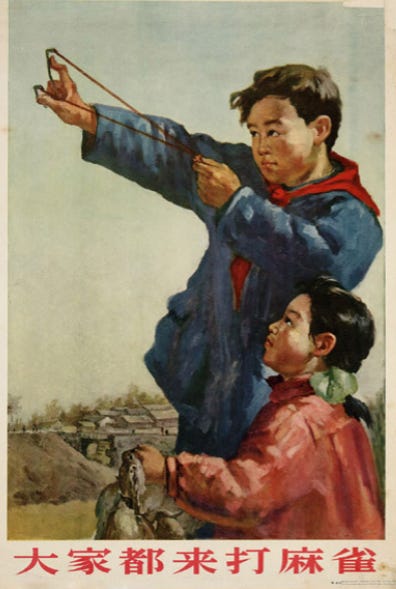
This campaign was part of the state’s efforts to eliminate four types of pest - mosquitoes, flies, rats and sparrows. This followed a purposeful shift by the state away from conducting science for the sake of knowledge, to that which could be useful to society.
The logic behind the elimination of sparrows was that they ate significant amounts of grain, reducing harvests. Hence, eliminating them would increase yields.
The entire population was mobilised in this effort. 210 million sparrows were killed, pushing the population near to extinction.
The result: insects - particularly locusts - thrived once their natural predator was removed. This was a contributory factor to a devastating famine which is estimated to have killed 10s of millions.
The experiment was eventually halted, and it was reported that China ended up repopulating its sparrow population by importing the birds from the USSR.
There aren’t many sources which go into much detail about this episode, though here are two:
Firstly, a 2019 dissertation titled “Away/With the Pest: Science, Visuality, and Socialist Subjectivities in Modern China’s Biosocial Abjection” by a PhD student at Wisconsin University:

Secondly, a working paper titled “Campaigning for Extinction: Eradication of Sparrows and the Great Famine in China” published by the National Bureau of Economic Research written in 2025:
One particularly notable feature of this episode is that there appears to have been widespread opposition from the scientific community at the time. Yet the state ploughed on regardless. To quote from the paper:
However, sparrows were included because they eat grains, but as pointed out by biologists, sparrows are also the natural enemies of many grain-eating insects, such as locusts, rice borer, rice planthopper, among others. The share that insects make up in the diet of sparrows changes throughout the year. In winter, when house sparrows tend to not migrate, sparrows mostly feed on grain and other agricultural products.
During the spring and summer months, insects constitute a large share of their diet, as high as 70-80% for fledgling sparrows (Yu et al. 2007). As a result, when the FPC included sparrows in their list of eradication, there was widespread opposition from scientists in China.
Most notably, Zhu Xi, a renowned biologist from the Chinese Academy of Sciences, voiced his opposition citing the historical episode of the Prussian king Frederick the Great trying to eliminate sparrows in 1744, but ended up with pest outbreaks and had to import sparrows from other countries to repopulate them. Zhu also analyzed examples of various cities in the US and Australia importing sparrows to help pest control, and warned Mao that more research is needed before deciding on the overall cost and benefit of sparrows. However, despite the opposition, Mao decided to go along with his plan to quickly eradicate sparrows nationwide.
If all this sounds rather familiar, it’s because such events - where ideology drives the most stupid decision-making - has become so commonplace it’s now the norm, rather than an exception.
If I sound frustrated, it’s because I am!
It was not an unintended consequence.
Mao knew what they needed to do. Destroy independent farmers and villages and force the population into the cities. State control followed.
Somewhat similar to the enclosure acts and highland clearances etc. etc.
“I know what, let’s block-out the sun” 😳